Friday, April 23, 2021

Pickers & Mixers

Experience is the worst teacher. It gives the test before giving the lesson.” — unknown
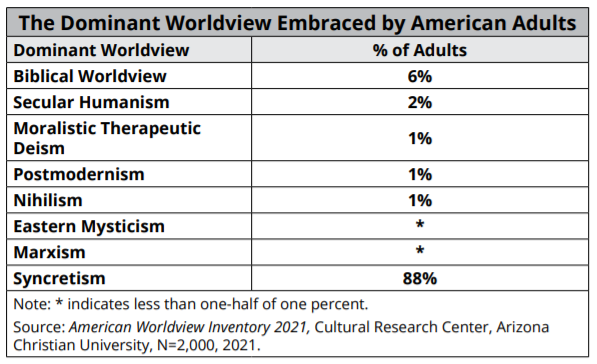
I came across the above study that shows the vast majority of Americans hold a syncretic worldview. I do have issues with this study, specifically as to how people were categorized and the bias of the source, but regardless let's go on the assumption (which I see very much anecdotally) that most people create their own worldview by pulling from various sources as well as being indoctrinated by the culture at large. Most of us who are spiritually and intellectually plugged-in are going to have syncretic tendencies anyways since we have been exposed to so much. We can't undo that. But perhaps we can decide to lean in to where Truth best reveals itself.

Maybe that's why Valentin Tomberg's Meditations of the Tarot was such an influential book for me. Tomberg was exposed to a lot of New Thought ideas, being a student of Rudolf Steiner, and having exposure to the Eastern religions and various esoteric and gnostic systems. But in the end, he chose the Catholic Church. 

How anachronistic of him! 

He could have kept his connection to the sacred without the institutional doctrine and demands of the Church. But I think in the end, he saw that New Thought ideas had its own cosmological dogma, high priests, and gatekeepers. Moreover, all his experiences confirmed for him that “the Roman Catholic Church is, in fact, a depository of Christian spiritual truth, and the more one advances on the way of free research for this truth, the more one approaches the Church. Sooner or later one inevitably experiences that spiritual reality corresponds—with an astonishing exactitude—to what the Church teaches” (Tomberg). Whether this was the cart leading the horse, he probably saw that Steiner's as well as other attempts to update the “spiritual science” was a futile in the arc of eternity. It became too abstract where the Church centered itself around a Person. 

It is easy when you reduce God to a spiritual science, people can begin to believe they are the source of their own divinity or if they believe in “God”, He has been reduced to a silent partner or a deist/pantheist God either removed from the natural world or just equal to it.

Most people aren't free thinking or intuitive enough to be syncretists. Today's culture at large often seems rudderless, selfish, and emotionally-centered, prioritizing a life of comfort and convenience. Thinking for oneself requires a lot of hard work and time. It can be decentering and uncomfortable. And it is unlikely most will be able to push themselves to create the proper conditions for spiritual growth on their own. (This is true for the religious as well as the just spiritual.)

Tracey Rowland makes an astute point in her book on theology, that when even adherents to Catholicism try to pick and mix different aspects of doctrine, it creates a “disintegrative pluralism” that can lead to disunity within oneself  and eventually the institution itself.

“Disintegrative pluralism occurs when people get so hooked on one part of the Christian kerygma that they begin to lose a panoramic vision. What should be a symphonic harmony is reduced to something quite discordant because one note or melody is drowning everything else. Typically some principle or doctrine is taken out of its rightful position and exaggerated or some fashionable concept becomes a hermeneutic through which every other part of Christian teaching must pass or else be sidelined. To put this principle another way, Catholic theology is renowned for its capacity to cope with mystery and with paradox and for its similarity to Gothic architecture. Just as every small piece of a Gothic cathedral has a role to play in maintaining the balance of the opposing structural tensions, so too, in Catholic theology, there is always a delicate balance between apparently antithetical ‘truths’ held in tension. When this tension is lost, when one single buttress is made to bear all the weight, because this particular buttress has become a fashionable subject of reflection, then all possibility of transcendence is lost and one is left with something quite defective, destined to collapse.”

Simone Weil said, “Each religion is alone true, that is to say, that at the moment we are thinking of it we must bring as much attention to bear on it as if there were nothing else ... A 'synthesis' of religion implies a lower quality of attention.” We are better off to go deep than wide. And as syncretists, it is too tempting to not purify the elements that need to be repudiated, especially when bucking against the culture at large. It is too easy to want to integrate everything in the milieu. But even then, we need to be able to see our loves rightly ordered. For even the Catholic Church tries to live up to its name (catholic meaning all embracing) by not excluding anything, even Hell, but remaining consistent by putting things in their proper order. All in all, this does not deny the immediate presence of God in all things.

If most of us are bound to be religious syncretists going forward, then God help us. Because there is probably no way we are going to be able to this rightly on our own.

Thursday, April 15, 2021

Niceness or God?

I've seen this period of pandemic cloistering challenge many relationships. I've witnessed break-ups and strains and those attempting to mend some old wounds, but it appears we are being prodded to operate on another plane than mundane existence. In my case (albeit a natural introvert), I've seen my outer world get a tad smaller while my inner world gets tossed around and stretched. Is this a good thing? Sure, why not. We are all discombobulating our comfort zones for a greater harmony. And in this harmony, we can occupy a higher moral space.

C. S. Lewis said,

“Morality, then, seems to be concerned with three things. Firstly, with fair play and harmony between individuals. Secondly, with what might be called tidying up or harmonising the things inside each individual. Thirdly, with the general purpose of human life as a whole: what man was made for: what course the whole fleet ought to be on: what tune the conductor of the band wants it to play. You may have noticed that modern people are nearly always thinking about the first thing and forgetting the other two.”

Perhaps during this time we are being nudged to sort ourselves out with “the other two.” I once had a date where the person said there is no need for religion, we just have to be nice to each other. If we settle for a therapeutic harmony of be nice-happy-content with others, then we will limit our gifts and moral aspirations to this world only. 

In truth, most of us are just being Dick's...

“As long as Dick does not turn to God, he thinks his niceness is his own, and just as long as he thinks that, it is not his own. It is when Dick realises that his niceness is not his own but a gift from God, and when he offers it back to God—it is just then that it begins to be really his own. For now Dick is beginning to take a share in his own creation. The only things we can keep are the things we freely give to God. What we try to keep for ourselves is just what we are sure to lose” (Lewis).

Without the transcendent, people become self-satisfied with their character. They want the heights of good experiences without the length of moral demands. But how will our experiences add up if they ultimately come to an end? They want the beauty of diverse tolerance without the rigor of unified principles. But who is more tolerant than the devil himself? 

We can't just be nicely swimming in the currents, without having any rocks to stand on. So our challenge is to find our rock. Some may believe all that is solid melts into air anyway so what is the point. But you can't even have air without an atmosphere that holds it all together!

As William Stoddard says: “People find themselves drowning in a sea of accidents; they do not know how to reach the one substance which alone is truth.” But there is a way to reach Truth. In one's life, solid ground can be found in the inner silence of sacredness, and the outer Tradition of cultural and religious wisdom. In the wisdom traditions, “these two components are always present: theodicy and soteriology; doctrine and method; theory and practice; dogma and sacrament; unity and union.”

We need to understand our relationship to God, and how to liberate ourselves to be closer to Him and His creation. Being nice just won't cut it. In fact, we may need to cut through it to see the Truth. 

“A world of nice people, content in their own niceness, looking no further, turned away from God, would be just as desperately in need of salvation as a miserable world—and might even be more difficult to save” (Lewis).

Monday, March 1, 2021

Between Melting and Freezing / The Soul’s Sap Quivers

Today's blog title is credited to T.S. Eliot, who happens to be a favorite poet of Shinzen Young, author of The Science of Enlightenment. Shinzen is also one of my favorite meditation teachers as of late. I find him to be extremely clear and gentle on the trials and tribulations of deep meditation practice, as well as appreciate his pragmatic and scientific approach with minimal Buddhist jargon. I still have an immense appreciation for Siddhartha Gautama's refined formulation of the original dharma (which Shinzen often pulls from), and continue to see these methods as part of my practice within the cosmology of a Catholic theocentric worldview. I look at Buddhist practice as bottom-up; and Christianity as top-down-all-around. It works for me.

Meditation is not always easy, and yet the only bad meditation is often the one we don't do. Even if the experience is challenging, there may be something good happening that we aren't aware of. Perhaps our soul is getting ready for what our mind isn't seeing yet. Meditation is even better if we don't resist the what and persist with the why. Meister Eckart says, “You should not attach such importance to what you feel; rather, consider important what you love and what you intend.”

In essence, we meditate to liberate ourselves to be present to Reality, to what is, to God. But even Shinzen acknowledges we can not directly experience God: “you only experience the afterglow of God.” God is too Real for our finite nervous systems to inhabit. 

But we must (as Thomas Merton once said about improving prayer life) take the time. We must take the time for practice for the sake of the practice itself. What comes of it will come in the right time, and yet there is always a vector to all of this. As Shinzen points out, we are made for practice as even our busy, aging minds point us toward the Real. 

“The ordinary mind is constantly scattered in many directions and cannot hold a center. We think this monkey-mind experience is awful. People feel tormented by this ceaseless turning of the mind. But when you look beneath surface appearances, the scattering can be interpreted as space effortlessly spreading, and the inability to hold a center could be looked upon as contraction gobbling up the solid ground beneath you.”

The solidity we hold on to is never relaxing. Even in our happiest conditioned moments (e.g. being in love, enjoying a favorite piece of music), there is still an underlying sense of more—or even that this experience will not satisfy due to it being unenduring. We approach an wide open canyon right at the point of a cliff that holds us back from leaping; or giving up our control or safety.

“When things solidify, when there’s pressure in body, mind, sight, or sound, people have a tendency to blame themselves: “I’m resisting.” “I can’t let go.” Expansion and contraction give us a different way to think about pressure and solidity. It doesn’t have to be about you at all; it’s about two impersonal forces eventually learning how to mutually interpenetrate without mutually interfering. Relating to unrelaxable solidity in this way can help you to develop equanimity.”

We first must recognize equanimously this subtle discomfort as a complete experience—for that is what is solidifying and standing in the way of our relationship to the Real. In practice, we go over and over this as we slowly and effectively uncover the True face that God wants to see. He doesn't want us to be safe and defensive; He wants us as we are fully alive!

Shinzen is quite a fan of The Cloud of Unknowing also. The author there says, “It is not who you are or what you've been that God sees with his merciful eyes, but what you want to be.”

Our anonymous friend adds, 

“Even meditating on God’s love must be put down and covered with a cloud of forgetting. Show your determination next. Let that joyful stirring of love make you resolute, and in its enthusiasm bravely step over meditation and reach up to penetrate the darkness above you. Then beat on that thick cloud of unknowing with the sharp arrow of longing and never stop loving, no matter what comes your way.”

This strong determination is an approach Shinzen acknowledges can get us all the way. The techniques suffice, but our intent is necessary.  

Between Melting and Freezing / The Soul’s Sap Quivers / Where is the summer, the unimaginable Zero summer? — T.S. Eliot

Friday, February 19, 2021

Sorry, You're Not Cool Anymore (A Rant to Leftist Boomers)

I recall a time when I felt sorry for being born too late and not living through the sixties as a young adult. I would fantasize in my reverie about the coolness of that decade, and the countercultural forces at play during that time. Not to mention all the libertine hedonic arrangements that would appeal to young man's zeal.  

But what in particular made the left cool in the sixties was an idealism that meant to break up the sclerosis in culture through rebellion and non-conformity. The revolutionaries at the time were aiming for truth, transparency, and integration.

Victor Davis Hanson says,

“The First Amendment was said by them to be sacred, even as the “free speech movement” transitioned to the “filthy speech movement.” Leftists sued to mainstream nudity in film. They wanted easy access to pornography. They mainstreamed crude profanity. The supposed right-wingers were repressed. They were the “control freaks” who sought to stop the further “liberation” of the common culture. 

In those days, the ACLU still defined the right of free expression as protecting the odious, whether the unhinged Nazis, the pathetic old-Left Communists, or nihilistic Weather Underground terrorists. 

“Censorship” was a dirty word. It purportedly involved the religious bigots and medieval minds that in vain had tried to cancel ideological and cultural mavericks and geniuses from Lenny Bruce to Dalton Trumbo. “Banned in Boston” was a sign of cretinism. Only drunken “paranoids” like Joe McCarthy resorted to “blacklists.” We were reminded that the inferior nuts tried to cancel the brilliant careers of their betters whom they disliked, or feared.”

Hanson continues,

“Civil and women’s rights were the twin pillars of the 1960s radicals. From Martin Luther King, Jr. to Malcolm X, the themes were for “white America” to live up to the ideals of their Constitution, to finally realize the “promises of the Declaration of Independence” and to treat people on the basis of the “content of their character” and not on “the color of their skin.” The problem was never 1776 or 1787, but those who had not yet fully met the Founders’ exceptional ideals.
A “color-blind society” was a ’60s sobriquet. Women strove to ensure girls had the same rights as boys, from leadership roles to sports. 
The point of the 1960s, again we were taught, was to tear down the rules, the traditions, and customs, the hierarchies of the old guys. The targets were supposedly the uptight, short-hair, square-tie, adult generation who grew up in the Depression, won World War II, and were fighting to defeat Cold War Soviet Union. 
The good guys, the students, and the activists, if they only had power, were going to break up corporations, shame (or “eat”) the rich, and bring in young, hip politicians.” 

In just a half-century, the boomers have become their parents (in the worst possible way) and have assimilated the generations below them—who in turn have decided to turn things up a notch by applying their insipid theories. While postmodern theory (now applied critical theory) may have seemed cool in the sixties as a form of mental masturbation, it has now wrought a heavy load on the academy, human resource departments, governmental institutions and media/entertainment. While there was a time when Derrida and Lacan may have seemed out of grasp for the average intellect, it now appears they never really had any intellectual grounding to begin with.

Today, truth, transparency, and integration have taken a back seat. The intellectual dishonesty of the left has overtaken many of the cultural institutions in order to protect their status. The media and high tech oligarchs have begun to shut down opposing views that don't fit the neo-liberal woke narrative, and integration has been limited to race, gender, and sex at the expense of ideas. 

In their wake, the leftist boomers of the sixties have given us: censorship of conservative ideas, electronic surveillance, high-tech oligarchs, cancel-culture, identity politics, book banning, white supremacy, micro-aggressions, safe-spaces, climate-change hysteria, breakdown of Tradition and religion, delegitimization of the working class, revisionist history, transhumanism, fears of domestic “terrorism”, and anti-patriotic globalism. 

Is this cool? Let's consider more deeply what it means to be “cool.”

James Kalb notes, 

“Coolness started with jazz musicians and still has something of the spirit of the night, of escape from everyday reality, of unconditioned freedom, of improvisation without a goal. It is the liberal equivalent of the divine grace that bloweth where it listeth and none can define. It has something in common with sanctity, inasmuch as the cool are in the world but not of it. They possess a certain disengagement, so that they are independent of their surroundings and not easily flustered or excited. They are not conventional and have a sort of perfect pitch in matters of perception, expression, and practical decision. Of course, coolness is also very different from sanctity. Sanctity is about eternity, coolness about now. It has religious aspirations, but its hedonism and individualism mean they go nowhere. The lives of the saints have enduring interest, because they point to something beyond themselves. The lives of the hipsters do not. This lack of substantive content allows coolness a place in the spiritual world of liberalism, but is otherwise a radical defect. Coolness makes things a matter of style, which is why a clumsy attempt to be a saint is admirable, while a clumsy attempt to be cool is ridiculous. This also means that coolness cannot maintain standards. Miles Davis is dead, hipsters have gone mass-market, and grade-school children now have as much right to be cool as anyone. At bottom, coolness is as silly as people think. It is notoriously unsustaining. Those who live by it either crash and burn, fall into gross hypocrisy (“sell out”), or grow out of it. Within the liberal order, though, growing out of it means growing out of the only thing, other than sex, drugs, celebrity, or lots and lots of money, that redeems life from quotidian dullness. It means turning into a boring, conventional, older person, just like Mom and Dad.”

Yup. Except Mom and Dad probably did believe in the eternal. Without institutional faith, and now being the sclerotic monolith of culture, the leftist boomers are no longer cool and have nothing enduring that will be redeemed by their fruits. Since the left often don't feel they need to belong to something, then there's really nothing to defend, and that makes it easier to feel superior. 

As Hanson quips: “They won. They are now one with—but also far, far worse than—what they rebelled against.”

Monday, February 8, 2021

Best Case Scenario: Agree with Decency to Disagree in Principle

Unity in the secular sense is futile and foolish. The ability to unify the diverse can only be grounded in the transcendent: “In God We Trust,” “E Pluribus Unum,” and “One Nation Under God.” Otherwise, it is not unity but only a uniformity that ultimately suppresses views.

You can try to unify a country under an ethnicity or a religion (not always such a good idea as history has shown) or you can unify a country around a great idea that allows for the free expression of ideas from people who are created equal, endowed with inalienable rights, and consent to be governed. But this form of unity needs to be grounded above, so it can be mirrored below. 

When it comes to political divisions, we are principally divided around narratives, human nature, reason, freedom, democracy, equality, and morality. You can't unify these divisions. The tensions must be inhabited under the One.

William Gairdner sums this up as follows, 

“While it may be true that many liberals are religious and many conservatives are not, the secular liberal narrative that all transcendent reality, morality, and law is to be dismissed as myth and banished from the public square remains dominant. Accordingly, the subtext is that secular humanist worship will continue to mean the worship of human progress and will. The conservative view has always been that human beings do better, and do less damage to others, by worshipping a transcendent God and living under a higher moral law they cannot change, than by worshipping themselves and living under a changeable human law that is vulnerable to the will of those who would manipulate them.”

In Gairdner's terrific book The Great Divide: Why Liberals and Conservatives Will Never, Ever Agree, he distills these principle divisions better than anything I've come across. The following tables are from his book:

Monday, February 1, 2021

Don't Fear Artificial Intelligence, Fear the Oracles

The fear over A.I. may be overblown. Certainly machines will continue to replace the menial aspects of what man can do. Machines will certainly have (and already have) an efficiency in regards to certain tasks that humans will unlikely ever be able to compete with. And yet, there will always be something humans possess that machines will never. The human will always be the machine's oracle. 

George Gilder says, “In an extension of Gödel’s incompleteness theorem—where the axioms of a system cannot be proved within that system—Turing showed the limits of computation: All computers are dependent on outside programmers that he called oracles.” 

The machines are deterministic by design, while human are creative by nature. 

“In order to have correspondence between logical systems and real world causes and effects, engineers have to interpret the symbols rigorously and control them punctiliously and continuously. Programmers have continually to enforce an interpretive scheme between symbols and objects that banishes all slippage. There can be no disproportionate “butterfly effects,” black swans, entrepreneurial surprises, radical entropy, or novelty” (Gilder).

Life is not deterministic, discreet, linear, and easily encodable. It is often analog, high-entropy, non-linear, and unpredictable. Therefore we are often forced to leap before we know. There is always an element of faith that we must take to interpret life. The machine can not do this. It is always at the beck and call of the programmer—who is the interpretant for the machine.  

There are also limitations to moving data around through silicon verses carbon. 

“The problem is that in every information system, the wires multiply by as much as the square of the number of nodes or transistors. Whether in brains as computer scientists understand them or in microprocessors as they make them, all intelligent processing is ultimately limited by connectivity” (Gilder).

As such, there is an inherent inefficiency with machines because they are always “dominated by the time required to move data between processor and memory.” Moreover, it is fascinating to note that “One human brain commands roughly as many connections as the entire internet.” While “computer networking and storage technology uses billions of times more energy than a single human brain, but is far less complex and multidimensional.”

It appears our Creator is way ahead of the game, as expected, since He created the game. While “AI assumes congruence of maps and territories”, man will always know the map is not the territory. The real problem is if man's map of reality is completely divorced from Reality. We are seeing this permeate ever more so in culture. Joel Kotkin paints a bleak picture of the neo-feudal shift we are seeing where our tech overlords are favoring identity politics, globalism, environmentalism, and transhumanism over self-determination, family, community, and traditional religion. 

Kotkin notes, “A world without traditional religion might still have people with spiritual awareness, but it would be short on the blessings of institutions that have promoted community, sacrifice, and faith for millennia.” Furthermore, 

“As Irving Kristol wrote almost two decades ago, the fundamental problem is that technological and scientific elites “have the inclination to think that the world is full of ‘problems’ to which they should seek ‘solutions.’ But the world isn’t full of problems; the world is full of other people.” Of course, he adds, there is no ‘solution’ to the existence of other people. All you can do is figure out a civilized accommodation with them’ ” (Kotkin).

Sadly, these elites are the oracles of our machines. Many of them adhere to the “new urban paradigm elevates efficiency and central control above privacy local autonomy class diversity and broad-based property ownership.” In addition, they “seek to profit from manipulating our moods, influence the behavior of our children, [and] structure our living environment as well.” 

Ideas have consequences, and we cannot love what we do not know. Many of the oligarchs have been indoctrinated into a monolithic neo-liberal worldview. Their disdain for tradition exacerbates a class conflict and leads to an oppressive environment to the consumers that will increasingly be dependent of their products. While they may have intentions for fairness of democratic values, few will be able to see beyond the inherent bias in the culture. The ones that do may be shunned or ostracized.  

Miguel Nicolelis says, “You cannot code intuition; you cannot code aesthetic beauty; you cannot code love or hate.” And yet, there will be those who will try to nudge machines to do as they like. This we must fear more than the machines themselves.

Saturday, January 9, 2021

Universalism's Dogma

“Modern thought insists on conceptual simplicity. It tends to create polarities and then suppress one of the poles.”James Kalb

We live in interesting times—always! As such, I am often trying to look past recent events to their causes. Not material causes necessarily, but metaphysical if at all possible. I do believe a fundamental aspect of today's extreme political factions stem from a move from a transcendent universalism to a worldly one.

The worldly universalism that I am pointing to that I see advancing is an imminent one only—where the aim is emancipate people from Tradition, from patriotic national identity, from Judeo-Christian religious affiliation, and from heritage values. These inherited institutions are now seen as unjust and therefore must be done away with. 

Instead, the only consensus allowed would be around a limited progressive diversity—a sort of pluralism without a coherent center. This movement toward a secular pluralistic system organizes itself around the dissent of fragmented political/cultural identities that compete for equality at the cost of liberty. Yet, this simplifies things by governing elites, allowing them to centralize control to manifest the agenda of suppressing non-liberal traditions that can now be outsourced to the state. 

But most of our social afflictions can't be solved by the state—especially one that intends to override local traditions and connections that truly unite people. Kalb notes, 

“Created things have inevitable limitations, and we live in a fallen world, but Christianity offers a way to transcend limitations and restore what is fallen through principles that place differences in perspective and make them part of a higher unity in which each contributes to the others, while maintaining its distinctiveness. It is radically at odds with liberal modernity, which abolishes the transcendent for the sake of a doomed attempt to construct a wholly this-worldly realm of peace, justice, and radical equality.”

It's not that state reform isn't relevant—but any change needs to be prudently contrasted against an absolute principle or it just becomes change for the sake of change! Is that change about fulfilling our deeper principles as a country and based on Reason, or undermining them for the sake of a global elitism and based on Will

Moreover, we as people are always adhering to some loyalties—even so called globalists. Human nature at its essence is tribal. The beauty of the nation-state is that it can cohere warring factions around a unifying center with transcendent-based principles. Yoram Hazony says, 

“The transition from an order of tribes and clans to the national state offers a great improvement in the possibilities for the collective self-determination of the tribes. This is because the great obstacle to the self-determination of clans and tribes when they are armed and politically independent is the incessant harm they do to one another through their relentless warfare. The national state takes advantage of the basis for a genuine mutual loyalty that already exists among these warring tribes—a common language or religion, in addition to a past history of defending one another as allies in the face of common enemies—to establish a unified national government, thus greatly relieving the constant proximity to war, while creating a vast new arena for the expression of a joint self-determination for these tribes.”

He goes on to say that, “no dramatic improvement occurs from national state to empire [globalist regime].” Such an unnatural organization around disparate states forces them into a false universalism not based on bonds, trust, or sentiment. People today see this as the trend, and for many, it does not serve them nor do they feel represented by it. It is as if they are outcasts slowly being dominated by a managerial elite who don't see them or the country they hold dear. 

“The nationalist, we may say, knows two very large things, and maintains them both in his soul at the same time: He knows that there is great truth and beauty in his own national traditions and in his own loyalty to them; and yet he also knows that they are not the sum of human knowledge, for there is also truth and beauty to be found elsewhere, which his own nation does not possess.”Yoram Hazony

Tuesday, December 22, 2020

Fake Young People

I took the title for this post from Bruce Charlton's recent discussion about old age, and the lack of lived wisdom that comes through in our culture. While I don't think elders were ever extensively revered to youth culture in the modern West, I do believe there were was a time when there were pockets of individuals that were able to transmit a certain degree of cultural inheritance that had significant influence. There was a reciprocity in this intergenerational relationship where the older generation was seen as valued as they bequeathed their life long gifts to the younger generation. But today, much of this has diminished as all generations are complicit in their denial of what is truly wise.

First, the older generation has refused to age gracefully. Instead, they fight it on every level. They make every attempt to keep their bodies young through strenuous exercise, health remedies, and cosmetic surgery. Sexual decline is manipulated through drugs. Recreational time is spent on travel, frivolous activities, and socializing. Their minds defer to youth culture, and the need need to “always stay young” by being in touch with whatever is novel. Instead of inspiring wisdom for the youth, it inspires pure vanity. The young will comment about how so-and-so looks great for their age, and yet it does little to impart any purpose for growing older other than making every attempt to delay the appearance of it. (sidebar: I speak from personal experience on this, as I am guilty of some of this vanity.)

The younger generation, although more innocent in regards to time, have their part to play. As they've grown up with internet culture, generational hierarchies of respect and reverence have collapsed. Images have taken over deep ideas. The youth are more prone to learn from memes and video clips than from perusing books. And if they read anything, it is rarely the classics. It's not that they stay outside of any ideas, it is more like they have become indoctrinated into the shallow ideas that permeate the stream of culture. Every so often, a viral father figure like Jordan Peterson will appear on the scene and inspire something that has been lost. Still, this needs to be made more pervasive for the impact to be enduring.  

Jacques Barzun once articulated as to what makes a nation. He says, “A large part of the answer to that question is: common historical memories. When the nation's history is poorly taught in schools, ignored by the young, and proudly rejected by qualified elders, awareness of tradition consists only in wanting to destroy it.” It does seem this is what we are up against on a socio-political scale. How are we to impart tradition if those with experience don't live it themselves?

It seems getting older should really be about embracing the transition—instead of struggling against it—all while cultivating and deepening our spiritual, intellectual and moral growth and maturity. Only through embodying any sort of depth, will we be able to inspire it. Chesterton said, “A dead thing can go with the stream, but only a living thing can go against it.” If we really want to be alive and youthful, we really need to, as David Bentley Hart once quipped about wisdom: recover our innocence at the far end of our experience! We can do this not by being pompous or didactic towards our ideas about life, but by being possessed by faith and reason.

We all know getting old isn't easy. We may see health issues begin the creep in, we lose attention from others as our appearance dulls, we may find ourselves lacking energy, and we tire of the need to keep up appearances that may have led us astray from what we really wanted. So it's easy to see where curmudgeonliness, shame, and regret can take hold if we are not centered! Or maybe we have been too enamored with our life's successes and refuse to allow for our demise. The bottom line is getting old is truly a time to prepare for death. It doesn't mean we stop living, but the finiteness of time gives us urgency towards life's significance. 

Despite all our advances it health care technology, we are still given a finite amount of time—and that has been the case for thousands of years. The Bible says explicitly, “The days of our years are threescore years and ten; and if by reason of strength they be fourscore years.” If you look at today's life expectancies, we have not moved too far off this scale. It is as if the human body has a generally defined time limit. So while youth may be wasted on the young, do we really want to allow old age to be wasted on staying fake young? It may be better we accept our days remaining and use them to impart our traditions and gifts among the youth who can truly hear/see, and prepare our transition to God's eternal home. 

Wednesday, December 9, 2020

Persons as Mystery (and Not Problems to Be Solved)

Frank Sheed says, “A Mystery is an invitation to the mind. For it means that there is an inexhaustible well of Truth from which the mind may drink and drink again in the certainty that the well will never run dry, that there will always be water for the mind's thirst.”

Persons are mysteries. They are not questions to be solved, or an ambiguities to the resolved. If they were, that would mean persons would be like problems that could be finitely determined. As such, that would end thought as well as the creative impulse to understand and wonder. It doesn't mean a person can't be understood, but like any mystery it can't be understood completely. There is something to a person that is inexhaustible and endlessly knowable. 

Today's secular world loses sight of this. Instead it prefers to see persons in terms of collectives or groups of collectives. This undermines the dignity of the person, and reduces the freedom he/she has to choose good and evil. We are very good at hiding this, because acknowledging sinful choice requires something of us. As Stanley Jaki notes about having sin move to the background: “moral responsibility is dulled so that sinful acts may not cause psychic trauma if they do not cause physical discomfort.”

As such, persons are seen as dependent on impersonal forces around economic conditions, social constructions, and systemic prejudices. Since persons are determined by outside forces, the mystery gets lost. Persons are now problems to be solved, where creativity gets stifled as these solutions can be seen simplistically through the eyes of packaged ideologies. Is this justice served, or just an approach to solve a problem and move on?

There is no doubt that modernity requires something of us to solve issues. After all, the whole impulse is about the perfectibility of man. But man can not be perfected when the mystery won't allow for monocausal origins. Moreover, social ills are always deeper than the materialistic plane will allow for.    

Rod Dreher notes,

“What we call social justice today, in a contemporary secular way, defines itself wholly in materialistic terms. The individual becomes nothing more than a bearer of his identity, within the cosmology of identity politics. Justice is determined mechanically, as if judging the affairs of men was no different than herding sheep or sorting butterbeans. Social justice, understood in this way, becomes monstrous.” 

Our material problems are truly spiritual solutions. As such, we need to recover the deeper metaphysic of persons as mystery, with the dignity to make choices and that those choices are rooted in something beyond the person himself. It does not mean that our choices will resolve the problems we endure, but that the nature of what we endure has meaning beyond the choice.

Friday, December 4, 2020

Living Not By Lies, Dying to Know Truth

Spending holidays with family is good way to know what ground you stand on. Sometimes it feels a tad shaky, but when you hear something that doesn't sit well with Reality you can find yourself standing up straight pretty quickly. I suppose that's what gets us closer to Truth, as it only happens some of us when we get a whiff of lies. Apparently, that's how it happened to Chesterton when he met someone with nihilistic tendencies he coined as the Diabolist. If we met this guy today, he'd probably be too commonplace to notice, and yet Chesterton was shocked enough by him that it propelled him to know its opposite—the Good and the True.

Chesterton was also astute to fact that the Good and True needed to be recognized through the veneer of cultural ideas of moral superiority: “We are altering, not the evils, but the standard of good which is the only standard by which any evil can be detected and defined.” Today's woke progressives adhere to the idea the good is redeemed by acknowledging privilege and demanding normalization and redemption to the marginalized. The evil is baked in the half-truths to the notion that justice can only be served to those victimized in group identities over the individual and universal. Therefore the system must be in control to serve justice—since nothing else can be: not I, not God. 

How does this differ from Chesterton's standard of Truth: which is always consistent, changeless, distinctive, whole, and of course, good!? Well for one thing, his version of Truth is so much more freeing! Yes, we know the Truth will set us free; however, the inverse is almost more important, in that in order to find Truth, we must be free to begin with. Sadly, the soft totalitarianism of cancel culture does not permit this to be the case. Since the system is racist, sexist, homophobic, transphobic, and fill in your favorite marginalized group phobia here, you are not allowed speak out of line with the tolerant (ironically intolerant) woke that knows best. (I suppose if your foundational pillars are fragile, then best to rule out disagreeing voices that may blow them over.)

Chesterton distilled some other essentials about Truth: that it is fun to put those ideas to the test and “that in knowing it and speaking it we are happy” (when does this ever happen with the left?). 

As such, it would seem to me the Truth should be on the short list of things worth preserving in this world. So that takes us to Rod Dreher, whose book Live Not By Lies takes on this very topic. Once we know Truth, we need to protect it, or conserve it (hence, the political movement known as conservatism). But it appears this is the least of our worries since we now don't understand ourselves “to be a pilgrim on a meaningful journey with others, but as a tourist who travelled through life according to his own self-designed itinerary, with personal happiness as the ultimate goal.” Hence, our values have become more therapeutically driven, and therefore very few are prepared to suffer for what matters.

Dreher notes, “We are being conditioned to surrender privacy and political liberties for the sake of comfort, convenience, and an artificially imposed social harmony.” This is the nature of soft totalitarianism—it does not terrorize us into surrendering our wills to the state like its harder form does—instead it lures us in with the therapeutic promises that will permit one a shallow happiness.

But real happiness requires more. We must love (and want to redeem) our neighbor, but as they are in the likeness of God. Unlike the woke social justice of today that divides LGBTQ+, BIPOC, women, and white European males, “Christian social justice sought to create conditions of unity that enabled all people—rich and poor alike—to live in solidarity and mutual charity as pilgrims on the road to unity with Christ.” 

The answer to this problem is a spiritual one: it starts with acknowledging the sin in each of us, the gift of suffering, and the gratitude for existence. Once we know this, we can die for it.