Wednesday, March 9, 2022

Next

I came to this conclusion recently: what we do with our life doesn’t matter all that much if it's just about our life. We overvalue our existence to accomplish things, and undervalue what we're already doing. As such, the key is not as to what we're doing, but how we can do it rightly: perhaps with more love; also with an understanding of our role in a grander narrative; maybe having more gratitude for our gifts and appreciating our constraints; and in the end, realizing our life wasn't about us but how we related to God and our fellow man & woman. 

I've come to this posture, as I am more concerned about having a holy death than a long life full of various activities. I hope to have some more years to repent, purify, and commune. But I have no grand ambitions, or even things I need to do on some checklist. I may decide to write a book, or not. I may decide to become a contemplative hermit for a period of time. Or I may fall and grow in love with someone. In any case, I am quite fine being a tad idle; however, not in a passive/bored/checked-out sort of way, but in an enchanted way. Therefore, it doesn't seem to matter as to what—but as to how

Recall the parting words in Middlemarch,

“But the effect of her being on those around her was incalculably diffusive: for the growing good of the world is partly dependent on unhistoric acts; and that things are not so ill with you and me as they might have been is half owing to the number who lived faithfully a hidden life, and rest in unvisited tombs.”

I've grown accustom to the hidden life. In fact, I wouldn't want it any other way. I couldn't imagine what it would be like to be Jordan Peterson or some other thought leader and have all those eyeballs on you. I don't want any of it. If what I write influences someone along the way then I am pleased to not even know it. What I do now is prioritized as to whether or not it brings me closer to God. The grain of culture, while always offering opportunities for growth and freedom, does not become my benchmark for progress. Nor does anything else that can be measured or quantified.

If we can allow for greater Truth to infuse our being and make it our life's practice, we will be prepared for eternity. In the meantime, we must endure the spiritual battle the ego insists upon. We must counter the moment to moment ego contraction with a moment to moment intentional undoing to be closer with God. That is the meaning to life that is not ours to make. Ratzinger makes the astute point, 

“Meaning that is self-made is in the last analysis no meaning. Meaning, that is, the ground on which our existence as a totality can stand and live, cannot be made but only received.”

Friday, February 25, 2022

It Starts with One (Primary) and Ends with All (Secondary)

There is tendency to look at the world these days and feel a tad pessimistic. Perhaps hopeful beyond this world, but still despondent about this world. It may have something to do with anti-intellectual relativism, lost virtues, corrupt institutions, new-age gnosticism, technocratic secularism, woke hysteria, hyper-capitalism, godless materialism and transhumanism. That's just for starters. In a more nuance fashion, D. C. Schindler hits on all the issues at the heart of the matter in his recent book, The Politics of the Real:

“There is a basic restlessness, a radical “mobility,” because there is no “anchor” in reality that would present a place of contemplative rest; Instead of real flourishing as the perfection of one’s actual nature, we find a more negative preoccupation above all with safety; Participation, or membership in a reality larger than oneself, is regularly trumped, not so much by the reality of the individual as by the activity of self-assertion; An essentially abstract sense of equality is taken to be a— perhaps the —governing ideal of social existence; Intrinsic meanings and values, which have their roots in actual realities and demand for their recognition the categories of goodness, truth, and beauty, are relentlessly functionalized, identified with what they achieve or produce, and measured by consequences; There is an all-encompassing drag toward materialism, both in the moral/existential sense of the reduction of goodness to economic value and in the properly metaphysical sense of a tendency to interpret “spiritual” realities exhaustively in terms of their material components; A sense of transcendence, in all of its manifestations, is either lost altogether, moralized, or sentimentalized; Cultural forms, and the taste and manners that accompany them, are minimized, held in contempt, or enacted only ironically; The capacity to understand and recognize genuine authority, and the capacity to hold and exercise it (these capacities cannot be separated from each other) disappear, and so authority is generally reduced to power; Political discourse, cut off from reference to the reality of intrinsic meaning that would give it substance and enable genuine deliberation, tends in a formalistic and functional way to the opposition of simple polarities; The profound principle of unity that allows the cultivation of beauty is excluded, and so art tends to fragment into the sentimental (art as kitsch or mere ornament) and the “edgy” (art as political statement)—or both at once; Technology increasingly saturates the culture, penetrating into the most intimate (social relations) and the most significant (work, both manual and intellectual) dimensions of human existence, so that, even when the excitement and curiosity fades and concern begins to set in, the culture can find no substantial resources for resistance; Absent the intrinsic organizing principle of form, there is a tendency toward sprawl in public building and social organization; Architectural style tends to fragment into either pure utility (whether that be measured by economic efficiency or ecological sensitivity) or the purely aesthetic, that is, the intrusion of features that are not only useless but inconvenient and intended only to produce a psychological effect; One witnesses a relentless, collusive effort to deny the essential meanings of things, rooted in the actual givenness of nature; an effort that is forced to go to extremes of absurdity and self-parody; Detached from its roots in the real, language tends to inflate, or to settle into the formulations of (technologically mediated) hip expressions or phrases and words “of the day,” accompanied by a tendency toward hyper-rhetoricization in speech, both public and private; The actuality of human judgment cedes its place increasingly to process, technique, and automation; The “peace” of order is generally imposed, enforced, and repaired through the essentially coercive means of political action, police and military force, and lawyers; Education ceases to be a formation of the person, through his introduction into the tradition, which he is meant to display and pass on in turn, and becomes instead training, the provision of the information and skills needed for individual success; The organization of human affairs, institutions, and collective endeavors tends to take the form of bureaucracy and formalized “management,” whenever it cannot simply be replaced by computer or machine; Philosophy is dethroned by science (and engineering) as the paradigm of human reason; There is a reduction of wisdom traditions to a culture of “scientifically-trained and certified experts”; Natural bonds, or those rooted in nature, are reinterpreted as far as possible from the ground up in terms of contracts (deliberately) entered into by (abstractly) “free” agents; Political authority is reduced to “the state,” which is either relied on in a disordered way (the “nanny state”), insofar as the bureaucratic structures replace the role of “natural” human institutions, or it is rejected as an artificial intrusion into one’s affairs (libertarianism); And finally tradition , rather than unifying a people, becomes a principle of diversity (“cultures and traditions”), and is thereby reduced to a superficial overlay—the seasoning one uses in cooking, the style of dress, taste in music, and so forth.”

There is always a part of us that may decide not to inquire where do we start?!, but to check out entirely! Obviously, this is always the cop-out. The temporal may be an image of the Real, but it's still God's image. The issue is always what is the relationship between the Real and its image. It's not like we can easily integrate them (in the Catholic integral sense or even the Ken Wilber integral sense). 

I like to think of the integralists like this sometimes: Take a clear glass of pure water (here is the Real). You can mix in a few drops of lemon. Fine (a proper image). A few drops of lime. Also fine (another proper image). And then there's a few drops of fecal matter. Not so fine (yucky image). Now I would never drink that water! For some, that's what integration can be. 

This may be a bit grim on a superficial level, so we always need clear, explicit discernment—and that sometimes means putting things in their proper order. I'll drink from the lemon/lime water, but use the poop to fertilize the lemon/lime tree. 

The bottom line is we need to begin with aligning ourselves to the Real beyond whatever cultural or political order we belong to. It starts with us individually before anything can happen. And nothing may happen collectively. We may not even make a dent to our immediate circles, never mind the culture at large, in any measurable way. Yet, there is an immeasurable change of heart in us which will always matter in God's eyes. 

Beyond this, it is still essential that we maintain the Christian virtue of hope, and not mistake this hope as belonging exclusively to our own individual salvation or liberation. God's creation will always matter and there will always be the deepest longing for the redemption of the whole world. It is important to keep this in mind, because otherwise the virtue of hope might seem to be in some ways selfish, with us not wanting to take part in history. 

The purpose of the earthly city is to provide the conditions which will allow human beings to develop themselves to the fullness of their gifts and in right relationship to the Real. And in this two things are necessary: that we live in fellowship with each other, and that we live in communion with God. However, I would not put this on equal footing: one is always primary; and that is our relationship to the Real is first!

Bruce Charlton recently wrote on his blog:

“There is an alternative way of being Christian - one which offers the possibility of a hopeful attitude to this moral world, and a sense of positive purpose for this mortal life; but it involves regarding tradition, orthodoxy, church, human-groups as being of secondary, not primary, importance. Indeed, I believe that the alternative is a deeper and more validly Christ-derived truth.”

I tend to agree.
Monday, January 3, 2022

Perennial Prescriptions

I don't really do New Year's resolutions anymore, since I now believe anything worth doing is worth doing always. Sure, there are minor practical considerations that often need tweaking, but best to get first things first right and all those other secondary matters will eventually line up in their proper order. 

In regards to those important primary matters, it's not like we can negotiate our way into them through some annual ritual. We have to want it ALWAYS—even if partially concealed with competing desires and commitments. 

And if you're not tending to those important things, eventually you will get signals you're going the wrong way. COVID has done that to many in my circles: not the virus itself, but the environment it created that forced many to look at themselves. So if I was to give advise for those looking to put what matters first, I would probably echo an excerpt I read from E.F. Schumacher's excellent book A Guide for the Perplexed.

I don't think these 'tasks' have to been done in a strict linear fashion as Schumacher details below, but could actually all be approached simultaneously while emphasizing some aspects over others depending on one's stage of life. I do agree with him that you have to at least start with the first and second to some extent. 

He says that,

“His first task is to learn from society and 'tradition' and to find his temporary happiness in receiving directions from outside.”

[Why re-create the wheel (or at least recognize you have been indoctrinated into one spoke of the wheel without being aware of the whole of it)? There is so much to learn from culture and tradition. And not a sclerotic tradition, but one that comes alive today. Human nature does not change much, and the real insights to Truth are eternal. The shoulders we stand on often have more originality and freshness than many of the contemporary thinkers of today. Learn from the past and present, with breadth, height, width, and depth.]

“His second task is to interiorise the knowledge he has gained, sift it, sort it out, keep the good and jettison the bad; this process may be called 'individuation', becoming self-directed.” 

[We are still individuals with particular inclinations. Not everything will resonate with everyone. The point is to integrate what does make you come alive and make it your own to embody; with your gifts; and to be lived with autonomy and mastery.]

“His third task is one that he cannot tackle until he has accomplished the first two, and for which he needs the very best help he can possibly find: it is 'dying' to oneself, to one's likes and dislikes, to all one's ego-centric preoccupations. To the extent that he succeeds in this, he ceases to be directed from outside, and he also ceases to be self-directed. He has gained freedom, or, one might say, he is then God-directed.”

[This is an endless task of praying, meditating, and contemplating that is really not a task. It is more an undoing. We undo our cravings around who we think we are to become as we really are. As t.k. says: “I” is a superstition masquerading as unquestionability. So better to always inquire what is Real beyond our ego-centered “I”.]

What I particularly like about Schumacher's prescription is it includes both the inner and outer path to God. I'm also reading W. Norris Clarke's The Philosophical Approach to God, where he states “It is one of the powerful perennial attractions of the Neoplatonic style of philosophy that the inner spiritual ascent of the soul to the One and the outer metaphysical ascent through the cosmos reveal themselves as two sides of the same coin. The spiritual and the metaphysical are not closed off from each other, but mirror each other in different orders.”

We are here to understand, and “to understand is ultimately to unify: it means first to discern the parts of anything clearly, but finally to unify them into a meaningful whole in itself and then with all else that we know” (Clarke).

Monday, November 29, 2021

The Metaverse: A Place Where We Will Be “Either Greater than Kings or Less than Men”

“Ultimately software-based humans will be vastly extended  beyond the severe limitations of humans as we know them today. They will live out on the Web, projecting bodies whenever they need or want them, including virtual bodies, foglet projected bodies, and physical bodies comprising nanobot swarms and other forms of nanotechnology.” — Ray Kurzweil

Something has not been created yet, and I'm already lambasting the idea of it. So be it, as I always happy to proved wrong (but let's leave my superego out of this). I may not be able to predict human progress, but I can sort of predict human nature. It was Toqueville who noted that Democratic citizens may someday see themselves “either greater than kings or less than men.” It does look like we have gotten nearly there, with the metaverse probably be the straw that breaks the camel's back. 

Today, we rarely look upward to God, but instead have supplanted any transcendent with manmade ideologies and the political state. We then buffer our world further still by looking inward through our constant barrage of technological distraction that disconnects us from substantive intimacy. And this has led to more isolation without any need for us to look outward towards our fellow citizens—many seen in contempt because they're boxed in to a subcategory of “other” without a shared universal identity. I can't see an easy way out, but moving our worlds further into virtual/augmented realities will probably just heighten our proclivity to dismantle our humanity.

After all, it was Stanley Kubrick who believed as we come to rely on technology to mediate our understanding of the world, it is our own intelligence that flattens out. So in other words, artificial intelligence won't come to us, but we will come to it. But what is it about such entrenched artificial medium that lessens our potential for being fully human?

Without any deeper meaning and right praise to the transcendent, it is too easy to fall into despair and to allow ourselves get distracted by entertainment and technology. The burden to cultivate meaning is too much when faith has been lost by the existing institutions. We may dabble in new age modalities, but this will never cultivate the time-tested institutions that have scaled shared practices, community, coherent doctrines, sacrifice, and faith for millennia. And I don't care how much futurists sell us the utopian visions as to how the metaverse will transform our world; it will always fall short of expectations of transforming the person (keep in mind they always toot their horns by their own evaluation criteria, such as material wealth, comfort, convenience, and a trivial enjoyment). 

The truth is the metaverse can never equate real life and existence. Existence is immeasurable and prior to anything created—instead of being an emergent property of manmade creativity. Living out one's life in some abstracted manmade environment can never compensate for real lived experience. Of course there are those who prefer the abstract to the real, such as our leftist managerial class. Allen says the left “do very little with their hands, and so tend to privilege form -- intellectual ideas and theories, design, structural adjustments and so on -- over function, over actually engaging with the real world.” Sounds like the metaverse will be primarily voting one way to its favor, while creating a deeper addiction to the simulation at the cost of real. 

Real life is also embodied, and as much as the metaverse can simulate sensate experience it will always be disconnected. The fully human embodied experience goes beyond superficial sensations on our skin and through our visual and auditory functions, but is a more deeply reciprocal relationship that involves our heart, intuition, intelligibility and the deep subtle sensations that lie beyond our skin. We engage reality with our whole person! Moreover, real life is also an open system allowing one to go beyond oneself while any simulated world is a closed system. There is no God in the metaverse, beyond another simulated limited object.

Offering people the ability the script-write their world leaves one cold towards humanity's significance. We will play god with our simulated life, instead of seeing our place in a cosmological journey where we are fated with limited choices and possibilities. The forthcoming metaverse will get closer to simulating a superficial sensate experience of the real, but in the end it will ultimately dim the person to meet a lesser baseline vitality of one's humanity while he/she is allowed to control a world that offers no meaning.

Friday, August 6, 2021

Unself or Unreal

I've been on blogging break due to the laziness that comes from the summer heat and my cultivation of unselfing a self of self-importance. In other words, I'm getting sick of myself trying to make a point or pontificating here. My inquiry and practice to Truth does not subside, but turns here and there while never straying too far from its unifying principle. But do I have to always write about it? Sometimes, I'd rather let it simmer or even shimmer. 

I have read some recent things that turns my attention to why smart people can be very stupid. While I can never be knowledgeable about everything, I weed out the chaff of books that probably don't need to be read. While I may be drawn to philosophy, I don't think I need to read most philosophers. Here's a good reason...

“...many students who take philosophy degrees have the distinct feeling that they’ve got on the wrong train. They expect to be dealing with the towering mysteries of human existence, they expect to be studying the accounts of the immortals who went before us, who attempted to scale the same heights, they expect to be guided on this odyssey by interesting people who have made the same journey and returned with pristine insights into the path ahead. What they find instead is a cross between a librarian and an accountant piling up items of knowledge like coloured beads then handing them out to confused and bored young people who are expected to categorise them in, at best, a slightly different way to those who preceded them” (Darren Allen).

That's why reading too much without a coherent center can fragment and frustrate the reader. And does it even change you for the better? Collecting all that information inflates the ego, and rarely opens one to being teachable. We know “People don’t first reason their way into their beliefs; they seek beliefs and attitudes which correspond to their felt inner reality, their way of living and their life-in-the-world, then find reasons to accept and defend those beliefs and attitudes; which is why reason cannot change them.” We can only be awakened from our deeper assumptions of reality. But that hurts too much for most.

And then there's the folks who claim street smarts, and like to point to their experience. But what do people really mean they know from experience? 

“Similarly, experience is ordinarily — and philosophically —understood piecemeal, as a series of knowable things that are learnt, remembered or possessed, rather than a totality which is lived. Ego can hardly be said to experience at all, instantly transporting whatever happens into the modal warehouse of the self, where it is stored, evaluated and used to get a better job, lord it over newcomers, or gas on about what it knows or what has happened to it. When people say ‘I have experience’ they nearly always mean that they possess something which is not experience, but the corpse of it.”

So we are always in the way of reality which can truly suck the life out of it. So to self-correct, we chase bigger vistas and thrills without bringing the whole self for the ride. 

“The isolating mind of the sleeping ego is like a blazing torch in the forest, over-illuminating a minute area of the dark, sharply dividing the user from everything else, which thereby seems both darker than the light and more uncannily different. To counter the threat of this obscure otherness, I turn up the torch, brighter and brighter, expanding my view further and further, but the light is so bright it now kills what it is directed at, petrifying the trees, shrivelling up the plants. I can see more and more, but fear of the darkness doesn’t decrease — in being suppressed, quite the opposite — so I turn up the beam higher and higher, looking for life in more and more distant realms, wiping out more and more life with the killing exposure, until, finally, I am left in a super-bright desert, blindingly overlit in every direction, and dead. All along, all I had to do was switch the torch off and grow accustomed to the darkness.”

So once again, we escape, overcompensate, indulge, but we never own our shite? That's because “Ego has two basic modi operandi; that of the physicalist, viewing reality as a matrix of cause and effect relationships, or that of the solipsist, for whom no laws, literal or otherwise, have any validity.” Which is like saying the non-physical aspect of ourselves doesn't have a part in existence or our non-physical selves are the center of existence. Either view fails. But then there are those who make a conscious effort to ‘transcend’ the ego. In this effort, they assume the ego is just a collection of thoughts, when there is so much more unconsciously stirring behind the scenes. So they spend...

“a great deal of time meditating, being mindful, jingo-jangling to DMT or swimming through esoteric oceans, often ends up being an extended psyche-wank which severs one’s participation to the represented world as it is — the shared canvas upon which the social self paints — which slowly becomes less interesting and less real, leaving ‘mystic’, meditating man, hovering round his magic, Romantic mind-realm, feeling tremendously wise and enlightened, while, in reality — the reality we share — he is well and truly up himself.”

This is what Allen terms as “orthophilia” or “compulsive avoidance of consciousness and context by over-focus on one’s emotional life, health or ‘spirituality’.”

Sounds dreadful, but been there and done that. 

In the end, we just need to unself through engaging God and disengaging our vices with an unwavering fanatical-like single mindedness. In seems our ancestors were right, albeit less sophisticated than us clever moderns. They did bear and struggle with it, but in our comforts of endless distraction we seem less willing to do so.

“Love God, with all your heart, and with all your will, and with all your mind, and with all your body, and renounce the devil, and all his works. Now and forever. So be it.”

* All quotes are from Darren Allen's excellent book Self and Unself.

Friday, April 23, 2021

Pickers & Mixers

Experience is the worst teacher. It gives the test before giving the lesson.” — unknown

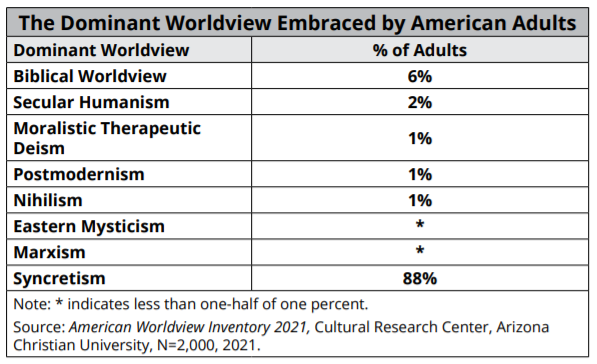
I came across the above study that shows the vast majority of Americans hold a syncretic worldview. I do have issues with this study, specifically as to how people were categorized and the bias of the source, but regardless let's go on the assumption (which I see very much anecdotally) that most people create their own worldview by pulling from various sources as well as being indoctrinated by the culture at large. Most of us who are spiritually and intellectually plugged-in are going to have syncretic tendencies anyways since we have been exposed to so much. We can't undo that. But perhaps we can decide to lean in to where Truth best reveals itself.

Maybe that's why Valentin Tomberg's Meditations of the Tarot was such an influential book for me. Tomberg was exposed to a lot of New Thought ideas, being a student of Rudolf Steiner, and having exposure to the Eastern religions and various esoteric and gnostic systems. But in the end, he chose the Catholic Church. 

How anachronistic of him! 

He could have kept his connection to the sacred without the institutional doctrine and demands of the Church. But I think in the end, he saw that New Thought ideas had its own cosmological dogma, high priests, and gatekeepers. Moreover, all his experiences confirmed for him that “the Roman Catholic Church is, in fact, a depository of Christian spiritual truth, and the more one advances on the way of free research for this truth, the more one approaches the Church. Sooner or later one inevitably experiences that spiritual reality corresponds—with an astonishing exactitude—to what the Church teaches” (Tomberg). Whether this was the cart leading the horse, he probably saw that Steiner's as well as other attempts to update the “spiritual science” was a futile in the arc of eternity. It became too abstract where the Church centered itself around a Person. 

It is easy when you reduce God to a spiritual science, people can begin to believe they are the source of their own divinity or if they believe in “God”, He has been reduced to a silent partner or a deist/pantheist God either removed from the natural world or just equal to it.

Most people aren't free thinking or intuitive enough to be syncretists. Today's culture at large often seems rudderless, selfish, and emotionally-centered, prioritizing a life of comfort and convenience. Thinking for oneself requires a lot of hard work and time. It can be decentering and uncomfortable. And it is unlikely most will be able to push themselves to create the proper conditions for spiritual growth on their own. (This is true for the religious as well as the just spiritual.)

Tracey Rowland makes an astute point in her book on theology, that when even adherents to Catholicism try to pick and mix different aspects of doctrine, it creates a “disintegrative pluralism” that can lead to disunity within oneself  and eventually the institution itself.

“Disintegrative pluralism occurs when people get so hooked on one part of the Christian kerygma that they begin to lose a panoramic vision. What should be a symphonic harmony is reduced to something quite discordant because one note or melody is drowning everything else. Typically some principle or doctrine is taken out of its rightful position and exaggerated or some fashionable concept becomes a hermeneutic through which every other part of Christian teaching must pass or else be sidelined. To put this principle another way, Catholic theology is renowned for its capacity to cope with mystery and with paradox and for its similarity to Gothic architecture. Just as every small piece of a Gothic cathedral has a role to play in maintaining the balance of the opposing structural tensions, so too, in Catholic theology, there is always a delicate balance between apparently antithetical ‘truths’ held in tension. When this tension is lost, when one single buttress is made to bear all the weight, because this particular buttress has become a fashionable subject of reflection, then all possibility of transcendence is lost and one is left with something quite defective, destined to collapse.”

Simone Weil said, “Each religion is alone true, that is to say, that at the moment we are thinking of it we must bring as much attention to bear on it as if there were nothing else ... A 'synthesis' of religion implies a lower quality of attention.” We are better off to go deep than wide. And as syncretists, it is too tempting to not purify the elements that need to be repudiated, especially when bucking against the culture at large. It is too easy to want to integrate everything in the milieu. But even then, we need to be able to see our loves rightly ordered. For even the Catholic Church tries to live up to its name (catholic meaning all embracing) by not excluding anything, even Hell, but remaining consistent by putting things in their proper order. All in all, this does not deny the immediate presence of God in all things.

If most of us are bound to be religious syncretists going forward, then God help us. Because there is probably no way we are going to be able to this rightly on our own.

Thursday, April 15, 2021

Niceness or God?

I've seen this period of pandemic cloistering challenge many relationships. I've witnessed break-ups and strains and those attempting to mend some old wounds, but it appears we are being prodded to operate on another plane than mundane existence. In my case (albeit a natural introvert), I've seen my outer world get a tad smaller while my inner world gets tossed around and stretched. Is this a good thing? Sure, why not. We are all discombobulating our comfort zones for a greater harmony. And in this harmony, we can occupy a higher moral space.

C. S. Lewis said,

“Morality, then, seems to be concerned with three things. Firstly, with fair play and harmony between individuals. Secondly, with what might be called tidying up or harmonising the things inside each individual. Thirdly, with the general purpose of human life as a whole: what man was made for: what course the whole fleet ought to be on: what tune the conductor of the band wants it to play. You may have noticed that modern people are nearly always thinking about the first thing and forgetting the other two.”

Perhaps during this time we are being nudged to sort ourselves out with “the other two.” I once had a date where the person said there is no need for religion, we just have to be nice to each other. If we settle for a therapeutic harmony of be nice-happy-content with others, then we will limit our gifts and moral aspirations to this world only. 

In truth, most of us are just being Dick's...

“As long as Dick does not turn to God, he thinks his niceness is his own, and just as long as he thinks that, it is not his own. It is when Dick realises that his niceness is not his own but a gift from God, and when he offers it back to God—it is just then that it begins to be really his own. For now Dick is beginning to take a share in his own creation. The only things we can keep are the things we freely give to God. What we try to keep for ourselves is just what we are sure to lose” (Lewis).

Without the transcendent, people become self-satisfied with their character. They want the heights of good experiences without the length of moral demands. But how will our experiences add up if they ultimately come to an end? They want the beauty of diverse tolerance without the rigor of unified principles. But who is more tolerant than the devil himself? 

We can't just be nicely swimming in the currents, without having any rocks to stand on. So our challenge is to find our rock. Some may believe all that is solid melts into air anyway so what is the point. But you can't even have air without an atmosphere that holds it all together!

As William Stoddard says: “People find themselves drowning in a sea of accidents; they do not know how to reach the one substance which alone is truth.” But there is a way to reach Truth. In one's life, solid ground can be found in the inner silence of sacredness, and the outer Tradition of cultural and religious wisdom. In the wisdom traditions, “these two components are always present: theodicy and soteriology; doctrine and method; theory and practice; dogma and sacrament; unity and union.”

We need to understand our relationship to God, and how to liberate ourselves to be closer to Him and His creation. Being nice just won't cut it. In fact, we may need to cut through it to see the Truth. 

“A world of nice people, content in their own niceness, looking no further, turned away from God, would be just as desperately in need of salvation as a miserable world—and might even be more difficult to save” (Lewis).

Monday, March 1, 2021

Between Melting and Freezing / The Soul’s Sap Quivers

Today's blog title is credited to T.S. Eliot, who happens to be a favorite poet of Shinzen Young, author of The Science of Enlightenment. Shinzen is also one of my favorite meditation teachers as of late. I find him to be extremely clear and gentle on the trials and tribulations of deep meditation practice, as well as appreciate his pragmatic and scientific approach with minimal Buddhist jargon. I still have an immense appreciation for Siddhartha Gautama's refined formulation of the original dharma (which Shinzen often pulls from), and continue to see these methods as part of my practice within the cosmology of a Catholic theocentric worldview. I look at Buddhist practice as bottom-up; and Christianity as top-down-all-around. It works for me.

Meditation is not always easy, and yet the only bad meditation is often the one we don't do. Even if the experience is challenging, there may be something good happening that we aren't aware of. Perhaps our soul is getting ready for what our mind isn't seeing yet. Meditation is even better if we don't resist the what and persist with the why. Meister Eckart says, “You should not attach such importance to what you feel; rather, consider important what you love and what you intend.”

In essence, we meditate to liberate ourselves to be present to Reality, to what is, to God. But even Shinzen acknowledges we can not directly experience God: “you only experience the afterglow of God.” God is too Real for our finite nervous systems to inhabit. 

But we must (as Thomas Merton once said about improving prayer life) take the time. We must take the time for practice for the sake of the practice itself. What comes of it will come in the right time, and yet there is always a vector to all of this. As Shinzen points out, we are made for practice as even our busy, aging minds point us toward the Real. 

“The ordinary mind is constantly scattered in many directions and cannot hold a center. We think this monkey-mind experience is awful. People feel tormented by this ceaseless turning of the mind. But when you look beneath surface appearances, the scattering can be interpreted as space effortlessly spreading, and the inability to hold a center could be looked upon as contraction gobbling up the solid ground beneath you.”

The solidity we hold on to is never relaxing. Even in our happiest conditioned moments (e.g. being in love, enjoying a favorite piece of music), there is still an underlying sense of more—or even that this experience will not satisfy due to it being unenduring. We approach an wide open canyon right at the point of a cliff that holds us back from leaping; or giving up our control or safety.

“When things solidify, when there’s pressure in body, mind, sight, or sound, people have a tendency to blame themselves: “I’m resisting.” “I can’t let go.” Expansion and contraction give us a different way to think about pressure and solidity. It doesn’t have to be about you at all; it’s about two impersonal forces eventually learning how to mutually interpenetrate without mutually interfering. Relating to unrelaxable solidity in this way can help you to develop equanimity.”

We first must recognize equanimously this subtle discomfort as a complete experience—for that is what is solidifying and standing in the way of our relationship to the Real. In practice, we go over and over this as we slowly and effectively uncover the True face that God wants to see. He doesn't want us to be safe and defensive; He wants us as we are fully alive!

Shinzen is quite a fan of The Cloud of Unknowing also. The author there says, “It is not who you are or what you've been that God sees with his merciful eyes, but what you want to be.”

Our anonymous friend adds, 

“Even meditating on God’s love must be put down and covered with a cloud of forgetting. Show your determination next. Let that joyful stirring of love make you resolute, and in its enthusiasm bravely step over meditation and reach up to penetrate the darkness above you. Then beat on that thick cloud of unknowing with the sharp arrow of longing and never stop loving, no matter what comes your way.”

This strong determination is an approach Shinzen acknowledges can get us all the way. The techniques suffice, but our intent is necessary.  

Between Melting and Freezing / The Soul’s Sap Quivers / Where is the summer, the unimaginable Zero summer? — T.S. Eliot

Friday, February 19, 2021

Sorry, You're Not Cool Anymore (A Rant to Leftist Boomers)

I recall a time when I felt sorry for being born too late and not living through the sixties as a young adult. I would fantasize in my reverie about the coolness of that decade, and the countercultural forces at play during that time. Not to mention all the libertine hedonic arrangements that would appeal to young man's zeal.  

But what in particular made the left cool in the sixties was an idealism that meant to break up the sclerosis in culture through rebellion and non-conformity. The revolutionaries at the time were aiming for truth, transparency, and integration.

Victor Davis Hanson says,

“The First Amendment was said by them to be sacred, even as the “free speech movement” transitioned to the “filthy speech movement.” Leftists sued to mainstream nudity in film. They wanted easy access to pornography. They mainstreamed crude profanity. The supposed right-wingers were repressed. They were the “control freaks” who sought to stop the further “liberation” of the common culture. 

In those days, the ACLU still defined the right of free expression as protecting the odious, whether the unhinged Nazis, the pathetic old-Left Communists, or nihilistic Weather Underground terrorists. 

“Censorship” was a dirty word. It purportedly involved the religious bigots and medieval minds that in vain had tried to cancel ideological and cultural mavericks and geniuses from Lenny Bruce to Dalton Trumbo. “Banned in Boston” was a sign of cretinism. Only drunken “paranoids” like Joe McCarthy resorted to “blacklists.” We were reminded that the inferior nuts tried to cancel the brilliant careers of their betters whom they disliked, or feared.”

Hanson continues,

“Civil and women’s rights were the twin pillars of the 1960s radicals. From Martin Luther King, Jr. to Malcolm X, the themes were for “white America” to live up to the ideals of their Constitution, to finally realize the “promises of the Declaration of Independence” and to treat people on the basis of the “content of their character” and not on “the color of their skin.” The problem was never 1776 or 1787, but those who had not yet fully met the Founders’ exceptional ideals.
A “color-blind society” was a ’60s sobriquet. Women strove to ensure girls had the same rights as boys, from leadership roles to sports. 
The point of the 1960s, again we were taught, was to tear down the rules, the traditions, and customs, the hierarchies of the old guys. The targets were supposedly the uptight, short-hair, square-tie, adult generation who grew up in the Depression, won World War II, and were fighting to defeat Cold War Soviet Union. 
The good guys, the students, and the activists, if they only had power, were going to break up corporations, shame (or “eat”) the rich, and bring in young, hip politicians.” 

In just a half-century, the boomers have become their parents (in the worst possible way) and have assimilated the generations below them—who in turn have decided to turn things up a notch by applying their insipid theories. While postmodern theory (now applied critical theory) may have seemed cool in the sixties as a form of mental masturbation, it has now wrought a heavy load on the academy, human resource departments, governmental institutions and media/entertainment. While there was a time when Derrida and Lacan may have seemed out of grasp for the average intellect, it now appears they never really had any intellectual grounding to begin with.

Today, truth, transparency, and integration have taken a back seat. The intellectual dishonesty of the left has overtaken many of the cultural institutions in order to protect their status. The media and high tech oligarchs have begun to shut down opposing views that don't fit the neo-liberal woke narrative, and integration has been limited to race, gender, and sex at the expense of ideas. 

In their wake, the leftist boomers of the sixties have given us: censorship of conservative ideas, electronic surveillance, high-tech oligarchs, cancel-culture, identity politics, book banning, white supremacy, micro-aggressions, safe-spaces, climate-change hysteria, breakdown of Tradition and religion, delegitimization of the working class, revisionist history, transhumanism, fears of domestic “terrorism”, and anti-patriotic globalism. 

Is this cool? Let's consider more deeply what it means to be “cool.”

James Kalb notes, 

“Coolness started with jazz musicians and still has something of the spirit of the night, of escape from everyday reality, of unconditioned freedom, of improvisation without a goal. It is the liberal equivalent of the divine grace that bloweth where it listeth and none can define. It has something in common with sanctity, inasmuch as the cool are in the world but not of it. They possess a certain disengagement, so that they are independent of their surroundings and not easily flustered or excited. They are not conventional and have a sort of perfect pitch in matters of perception, expression, and practical decision. Of course, coolness is also very different from sanctity. Sanctity is about eternity, coolness about now. It has religious aspirations, but its hedonism and individualism mean they go nowhere. The lives of the saints have enduring interest, because they point to something beyond themselves. The lives of the hipsters do not. This lack of substantive content allows coolness a place in the spiritual world of liberalism, but is otherwise a radical defect. Coolness makes things a matter of style, which is why a clumsy attempt to be a saint is admirable, while a clumsy attempt to be cool is ridiculous. This also means that coolness cannot maintain standards. Miles Davis is dead, hipsters have gone mass-market, and grade-school children now have as much right to be cool as anyone. At bottom, coolness is as silly as people think. It is notoriously unsustaining. Those who live by it either crash and burn, fall into gross hypocrisy (“sell out”), or grow out of it. Within the liberal order, though, growing out of it means growing out of the only thing, other than sex, drugs, celebrity, or lots and lots of money, that redeems life from quotidian dullness. It means turning into a boring, conventional, older person, just like Mom and Dad.”

Yup. Except Mom and Dad probably did believe in the eternal. Without institutional faith, and now being the sclerotic monolith of culture, the leftist boomers are no longer cool and have nothing enduring that will be redeemed by their fruits. Since the left often don't feel they need to belong to something, then there's really nothing to defend, and that makes it easier to feel superior. 

As Hanson quips: “They won. They are now one with—but also far, far worse than—what they rebelled against.”

Monday, February 8, 2021

Best Case Scenario: Agree with Decency to Disagree in Principle

Unity in the secular sense is futile and foolish. The ability to unify the diverse can only be grounded in the transcendent: “In God We Trust,” “E Pluribus Unum,” and “One Nation Under God.” Otherwise, it is not unity but only a uniformity that ultimately suppresses views.

You can try to unify a country under an ethnicity or a religion (not always such a good idea as history has shown) or you can unify a country around a great idea that allows for the free expression of ideas from people who are created equal, endowed with inalienable rights, and consent to be governed. But this form of unity needs to be grounded above, so it can be mirrored below. 

When it comes to political divisions, we are principally divided around narratives, human nature, reason, freedom, democracy, equality, and morality. You can't unify these divisions. The tensions must be inhabited under the One.

William Gairdner sums this up as follows, 

“While it may be true that many liberals are religious and many conservatives are not, the secular liberal narrative that all transcendent reality, morality, and law is to be dismissed as myth and banished from the public square remains dominant. Accordingly, the subtext is that secular humanist worship will continue to mean the worship of human progress and will. The conservative view has always been that human beings do better, and do less damage to others, by worshipping a transcendent God and living under a higher moral law they cannot change, than by worshipping themselves and living under a changeable human law that is vulnerable to the will of those who would manipulate them.”

In Gairdner's terrific book The Great Divide: Why Liberals and Conservatives Will Never, Ever Agree, he distills these principle divisions better than anything I've come across. The following tables are from his book: